Electronics Extraction (The Defumener): Difference between revisions
No edit summary |
No edit summary |
||
| Line 18: | Line 18: | ||
The extraction is still in development, but most of the parts have now arrived. | The extraction is still in development, but most of the parts have now arrived. | ||
The bench noodles have been named Henry and Manny by [[User:Starmouse]]. | The bench noodles have been named Henry and Manny by [[User:Starmouse|Emily]]. | ||
==Construction== | ==Construction== | ||
| Line 24: | Line 24: | ||
The bulk of the extraction is made from standard extraction parts. The PVC ducting is from Screwfix, as are the hose clips and tees. The extractor fan is intended for bathrooms, and was purchased from Amazon. | The bulk of the extraction is made from standard extraction parts. The PVC ducting is from Screwfix, as are the hose clips and tees. The extractor fan is intended for bathrooms, and was purchased from Amazon. | ||
==The Noozles== | ===The Noozles=== | ||
Meet Henry and Manny. These guys love flux smoke - do not forget to feed them by turning on the extractor fan while soldering. The noozles were purchased from AliExpress and are essentially (knock-off) loc-line with silicone nozzles. They needed eyes though! | Meet Henry and Manny. These guys love flux smoke - do not forget to feed them by turning on the extractor fan while soldering. The noozles were purchased from AliExpress and are essentially (knock-off) loc-line with silicone nozzles. They needed eyes though! | ||
| Line 30: | Line 30: | ||
The noozles plug into 3D printed bases mounted to the bench. On the underside, the ducting attaches to a different but similar 3D print. | The noozles plug into 3D printed bases mounted to the bench. On the underside, the ducting attaches to a different but similar 3D print. | ||
( | <gallery> | ||
File:ExtractionNoozle.jpg|The noozle with eyes. | |||
File:ExtractionEyes.jpg|The eye sockets / eyes. | |||
</gallery> | |||
OpenSCAD for googly eye mounts: | |||
<pre> | |||
$fn = 300; | |||
gap = 3.1; | |||
gapShift = gap / 2; | |||
// Basic construction | |||
translate([-5, 0, gapShift]) | |||
cube([10, 10, 3]); | |||
translate([-5, 0, -gapShift-3]) | |||
cube([10, 10, 3]); | |||
translate([0, 0, 0]) | |||
rotate([90, 0, 0]) | |||
cylinder(3, 15/2, 15/2); | |||
// Add little grippers | |||
for (i = [1:1:4]) { | |||
translate([-5, i*2, -gapShift]) | |||
rotate([-45, 0, 0]) | |||
cube([10, 0.4, 0.4]); | |||
translate([-5, i*2, gapShift]) | |||
rotate([-45, 0, 0]) | |||
cube([10, 0.4, 0.4]); | |||
} | |||
</pre> | |||
Revision as of 17:39, 27 January 2025
| Electronics Extraction (The Defumener) | |
|---|---|
| Manufacturer | Nottingham Hackspace |
| Model | Defumener |
| AKA | Defumener |
| Obtained | Pledge Drive (Jan 2025) |
| Location | Electronics Area |
| Team | Electronics |
| Induction Required | No |
| Tools: all pages • list • Power Tools • Broken tools {{}} | |
As part of the 2025 Electronics Pledge Drive, ducting, extraction nozzles, various connectors, hose clips and an extractor fan were purchased. This is to improve the air quality of the Electronics Area while soldering, and to support the use of the T-962A Reflow Oven.
The extraction is still in development, but most of the parts have now arrived.
The bench noodles have been named Henry and Manny by Emily.
Construction
The bulk of the extraction is made from standard extraction parts. The PVC ducting is from Screwfix, as are the hose clips and tees. The extractor fan is intended for bathrooms, and was purchased from Amazon.
The Noozles
Meet Henry and Manny. These guys love flux smoke - do not forget to feed them by turning on the extractor fan while soldering. The noozles were purchased from AliExpress and are essentially (knock-off) loc-line with silicone nozzles. They needed eyes though!
The noozles plug into 3D printed bases mounted to the bench. On the underside, the ducting attaches to a different but similar 3D print.
-
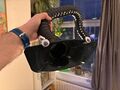 The noozle with eyes.
 -
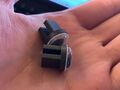 The eye sockets / eyes.


OpenSCAD for googly eye mounts:
$fn = 300;

gap = 3.1;

gapShift = gap / 2;

// Basic construction
translate([-5, 0, gapShift])
    cube([10, 10, 3]);
translate([-5, 0, -gapShift-3])
    cube([10, 10, 3]);
translate([0, 0, 0])
    rotate([90, 0, 0])
    cylinder(3, 15/2, 15/2);

// Add little grippers
for (i = [1:1:4]) {
    translate([-5, i*2, -gapShift])
        rotate([-45, 0, 0])
        cube([10, 0.4, 0.4]);
    translate([-5, i*2, gapShift])
        rotate([-45, 0, 0])
        cube([10, 0.4, 0.4]);
}